
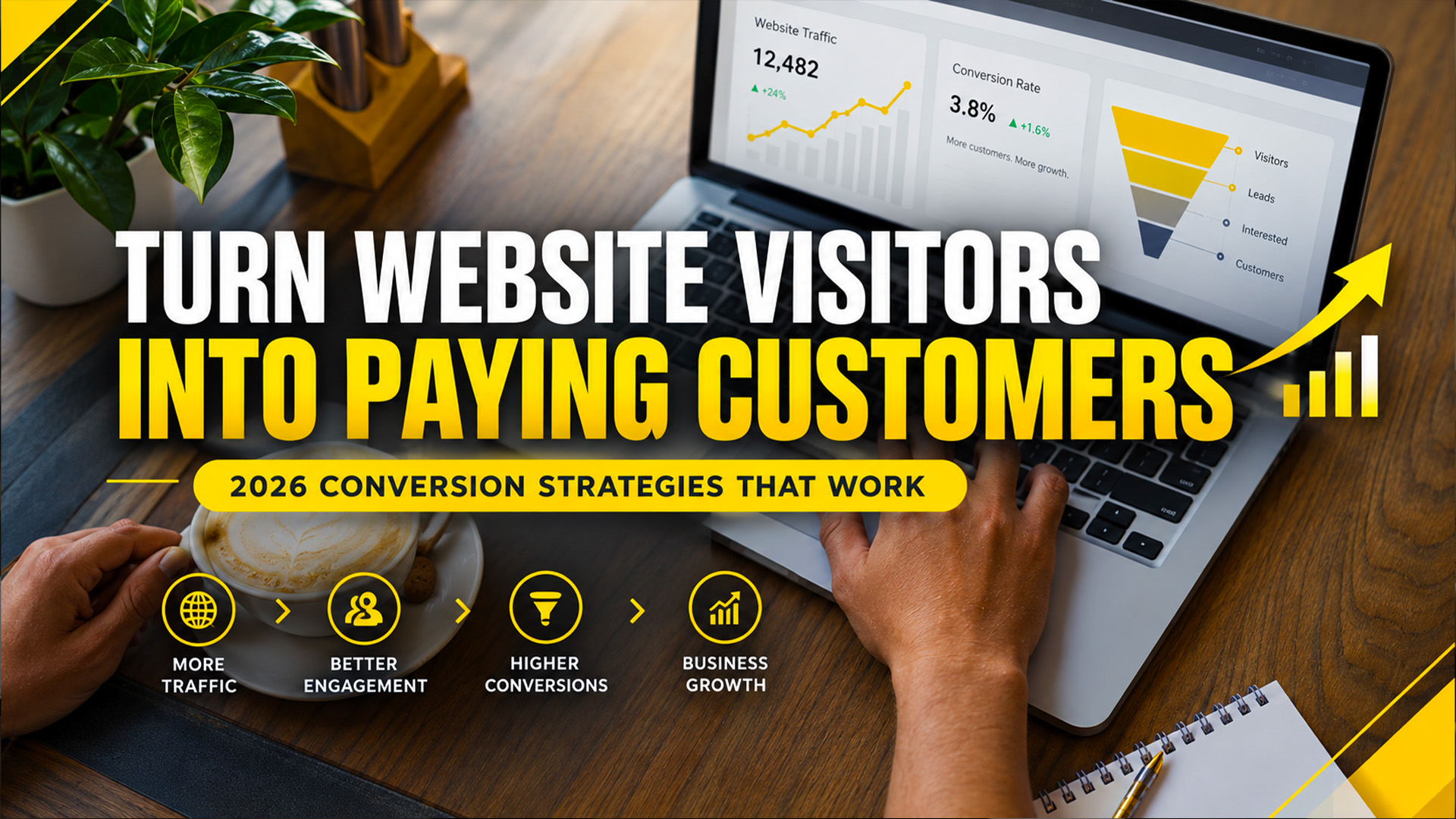
You worked to get people to your website. You ran the ads. You published the content. You put in the time and the budget and the effort, and people showed up. They clicked through, landed on your page, looked around.
And then they left.
No purchase. No inquiry. No sign-up. Just a bounce rate sitting in your analytics, quietly telling you that something between the visit and the decision isn’t working.
That’s the real problem most businesses are sitting with right now. Not traffic. Conversion.

There’s a version of the traffic conversation that makes it sound like the goal is just to get more people through the door. Get enough visitors, and the sales will follow. That’s not how it works.
A website full of visitors who don’t buy anything isn’t a success. It’s an expensive way to find out that something is broken. And the fix rarely involves spending more on ads or producing more content. It involves looking honestly at what happens after someone arrives — and fixing the parts of that experience that are quietly losing you business every single day.
Here’s what those parts usually are:
Make Your Website Easy to Navigate
Put yourself in the position of someone visiting your site for the first time. They don’t know your layout. They don’t know where you’ve put things. They have a question, and they need to find the answer fast because they have six other tabs open and zero patience for a confusing menu.
If they can’t find what they’re looking for in the first few seconds, they won’t keep looking. They’ll leave. And they’ll find a competitor whose website made it easy.
The fix isn’t complicated. Clear categories. Logical menu labels. The most important information- pricing, services, contact details needs to be exactly where people expect it to be. Friction in navigation is friction on the path to a sale. Remove it wherever it exists.
Build Trust Before Asking for a Sale
Here is something worth sitting with. When someone lands on your website, their default position is skepticism. Not hostility, just caution. They’ve been let down by businesses before. They’ve read descriptions that oversold and received products that under delivered. They’re careful now.
Your website has to earn their trust before it asks for anything.
That means real testimonials, not generic praise. Case studies that show actual outcomes. Service descriptions that are honest about what’s included and what isn’t. A team page that puts a face to the business. Transparent policies. Secure checkout. Every one of those details answers a quiet question the visitor is asking, and every question you answer is one less reason for them to hesitate.
Trust isn’t built in a single visit. But it’s lost in one bad impression. Make every detail on your site work toward building it.
Create Landing Pages That Speak to Your Audience
Not every visitor arrives at your site with the same intention.
Some are early in the process of researching, comparing, and just aren’t ready to commit. Some are further along; they know what they want, and they just need to find the right provider. Some are ready to act right now and just need a clear path to do it. Sending all of them to the same generic homepage and hoping for the best is a missed opportunity.
Targeted landing pages solve this. A page built around a specific service, a specific audience, or a specific problem performs better than a page trying to say everything to everyone. It speaks directly to the person reading it. It answers the questions that particular visitor is likely to have. And it gives them one clear next step rather than five confusing options.
The more relevant the page feels, the more likely someone is to stay on it long enough to become a lead.
Respond to Customer Questions Quickly
Sales are lost in the gap between a question and an answer.
A customer is interested. They’re close to making a decision. But they have one thing they need to know first about shipping, the service process, and what happens after they sign up. They look for the answer. They don’t find it easily. They move on.
That story plays out constantly, across every industry and every type of business. And the fix is straightforward: make it easy for people to get answers quickly.
Live chat, well-organized FAQs, responsive email support — these aren’t extras. They’re part of the conversion process. A customer who gets a clear, prompt answer to their question has one less reason to hesitate. Remove enough reasons and the decision becomes easy.
Use Data to Improve Your Conversion Strategy
Assumptions are expensive.
It’s tempting to look at a page that isn’t converting and have a theory about why. The headline is wrong. The layout is off. The offer isn’t compelling enough. Maybe. But maybe not. Acting on a theory without data means you might fix the wrong thing and the problem stays exactly where it was.
Analytics tools like Google Analytics and Microsoft Clarity show you what’s actually happening. Where people enter. Where they drop off. What they click on and what they scroll past. Which step in the checkout process is losing you half your sales? That information turns vague problems into specific ones — and specific problems are solvable.
Test a different headline. Try a cleaner checkout flow. Change the button text. See what the numbers say. Do it again. Small, consistent improvements build on each other, and over time they add up to a very different conversion rate.
These five things don’t work in isolation.
Navigation sets the foundation; people can only convert if they can find what they’re looking for. Trust keeps them from leaving the moment doubt creeps in. Targeted landing pages make the offer feel relevant rather than generic. Fast, helpful support removes the final hesitations. And data makes sure the whole system keeps getting better instead of staying stuck.
Together, they address the customer journey at every stage. Not just the moment of arrival, and not just the moment of decision, but everything in between, which is where most sales are actually won or lost.
More traffic is not always the answer. Sometimes the answer is doing more with the visitors you already have, understanding what they need, removing what’s in their way, and making it as easy as possible for them to choose you.
OneVirtual Solutions helps businesses build a customer journey that actually works. From the first website visit to the final sale. Our virtual assistants and AI-supported solutions handle lead management, customer inquiries, follow-up coordination, and ongoing communication so potential customers stay engaged at every stage of the process.
You don’t need to start from scratch. You need the right support in the right places.
Schedule a free consultation with OneVirtual Solutions today. Let’s find where your business is losing customers and fix it.